
 By onlyinterviews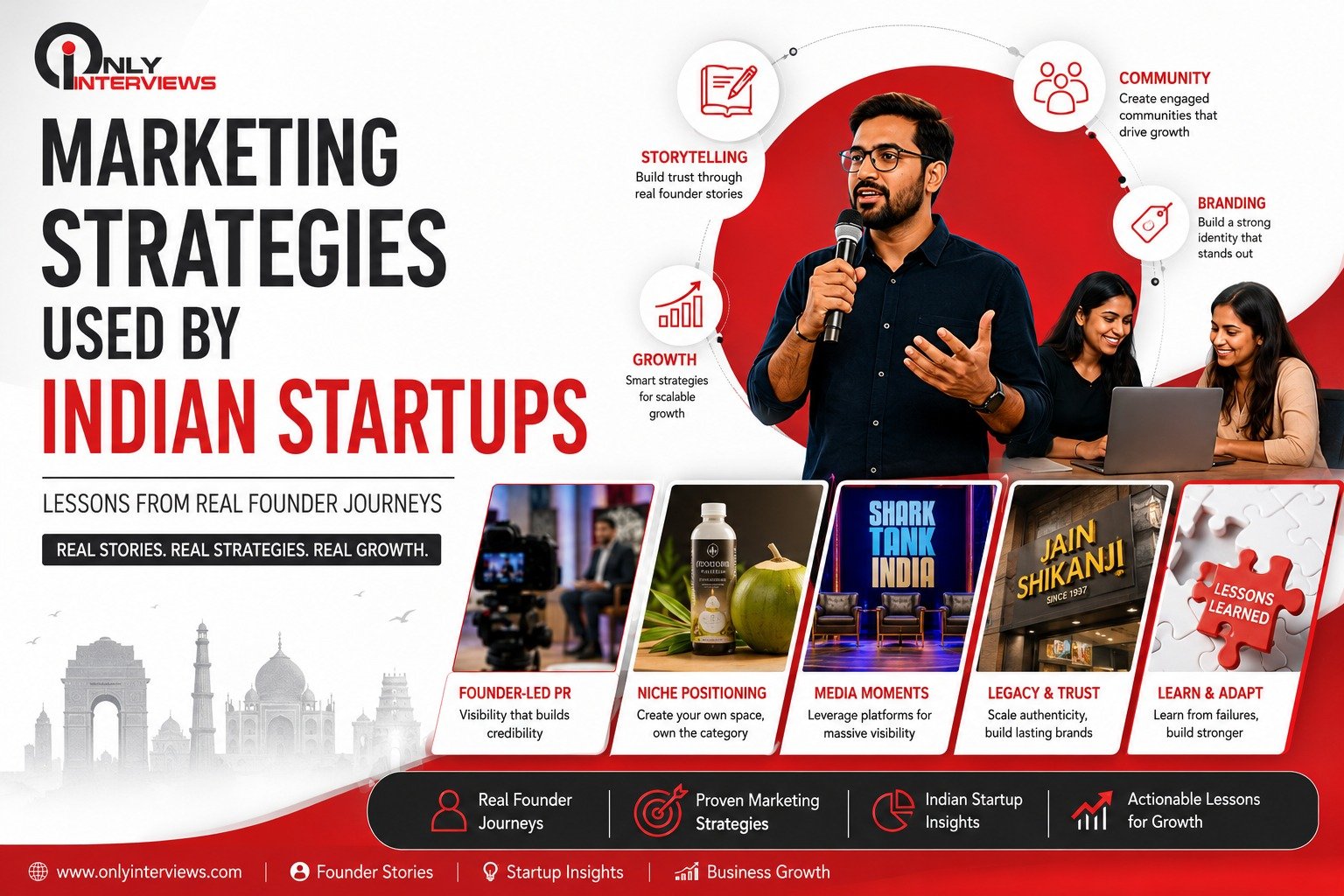
India’s startup ecosystem has crossed the stage where a good product alone guarantees survival. With thousands of new ventures launching every year across sectors — from D2C wellness brands to digital healthcare platforms — marketing has become the real differentiator between a startup that scales and one that quietly shuts down. What’s interesting is that Indian founders rarely follow a single textbook playbook. Instead, most build marketing strategies shaped by tight budgets, regional diversity, and a deep understanding of local trust signals.
At Only Interviews, we’ve spoken with dozens of founders who built recognisable brands from scratch. Their stories reveal patterns that go far beyond generic “digital marketing tips” — patterns rooted in storytelling, community, and founder visibility. Here’s a closer look at the marketing strategies actually working for Indian startups today.
1. Founder-Led Storytelling Builds Trust Faster Than Ads
One of the most consistent strategies among Indian startups is putting the founder’s personal journey front and centre. Customers in India tend to trust a face and a story more than a polished ad campaign, especially in early-stage growth. This is why founder interviews, LinkedIn narratives, and podcast appearances have become core marketing channels rather than side activities.
Series like Founder Journey Stories That Inspire Everyone show why this works: readers connect with the struggle, the pivot, and the honesty of the journey long before they connect with the product itself. Founders such as Drasti Chauhan, who transitioned from a semiconductor engineering career into entrepreneurship and authorship, used her personal transformation story as a marketing asset — turning her own credibility into brand credibility.
2. Category Creation Through Niche Positioning
Rather than competing head-on in crowded categories, many Indian startups win by creating a niche that didn’t clearly exist before, and then owning the narrative around it. This is a deliberate marketing strategy, not an accident — it reduces direct comparison and lets the startup define the conversation.
A good example is the coconut-based wellness beverage space, where Cocofit’s founder Sashi Kanth Visinigiri built a brand around a traditional Indian ingredient repositioned for a modern QSR and wellness audience. By anchoring the marketing message to cultural familiarity plus a new consumption format, the brand avoided competing purely on price or shelf space.
3. Leveraging Shark Tank and Media Moments for Distribution
National television and high-visibility media moments remain one of the fastest ways for an Indian startup to gain instant brand recall. Appearing on a show like Shark Tank India doesn’t just bring funding — it becomes a marketing event in itself, generating organic search volume, social shares, and press coverage that a startup would otherwise spend lakhs to buy.
The story of Pharmallama, a digital pharmacy startup, illustrates both the upside and the complexity of this strategy — the visibility helped the brand reach patients faster, but it also had to navigate real regulatory challenges once under the public spotlight. This is an important marketing lesson: media attention accelerates growth, but only startups with operational readiness can convert that attention into retention.
4. Community Trust and Legacy Branding
Not every successful Indian brand is a VC-funded startup chasing hypergrowth. Many of the strongest marketing case studies come from businesses that leaned into decades of community trust and family legacy, then modernised their packaging, distribution, and digital presence without losing that heritage positioning.
The Jain Shikanji journey from a family legacy to a national brand is a strong example of this approach — the marketing strategy wasn’t about disrupting the category, but about scaling authenticity, which is often a more durable growth lever than aggressive paid acquisition.
5. Learning from What Doesn’t Work
A mature marketing strategy also includes honestly studying failure. Indian startup media has started documenting not just the wins but the shutdowns, and these stories are becoming genuinely useful marketing and strategy resources for other founders.
The account of Elcare India’s rise and fall, an eldercare startup, is a reminder that no amount of marketing spend can substitute for product-market fit and sustainable unit economics. For founders and marketers alike, these post-mortems are as valuable as the growth playbooks.
6. Consistent Content and PR Across the Founder’s Career
Finally, the startups that sustain visibility over years — not just during a funding announcement — tend to treat PR and content as an ongoing marketing function rather than a one-time launch activity. Regular interview features, category-specific press coverage, and consistent founder commentary compound over time, improving both brand recall and organic search visibility.
Platforms that focus specifically on candid founder interviews and startup stories give early-stage Indian founders a low-cost way to build this ongoing narrative, especially when paid marketing budgets are limited in the early stages.
Conclusion: There’s No Single Playbook, Only Patterns
Across every example above, one theme stands out: Indian startups that market well tend to combine a strong founder narrative with deep cultural or community relevance, and they treat media visibility as compounding infrastructure rather than a one-off event. Whether it’s storytelling, niche positioning, viral media moments, legacy branding, or transparent failure analysis, the common thread is authenticity over polish.
If you’re building a startup and want to study how other Indian founders approached branding, growth, and public narrative, explore more founder interviews and entrepreneur stories on Only Interviews — or browse the full blog section for more startup marketing case studies from across India.