
 By onlyinterviews
Real Lessons From India’s Startup Trenches
There’s a moment every founder remembers — not the funding announcement, not the press release, but the 2 a.m. moment when the product broke, the co-founder walked out, or the bank balance hit zero. Nobody puts that moment on a LinkedIn banner. But it’s usually the moment the real story begins.
At OnlyInterviews, we’ve spoken with founders across fintech, D2C, SaaS, and consumer tech — some who’ve raised crores from Sharks on national television, like the team behind Pharmallama’s digital pharmacy journey, others who bootstrapped from a single laptop in a Tier-2 city. What strikes us every time isn’t the exit valuation. It’s the pattern underneath it: almost every founder journey worth telling starts with a problem nobody else was willing to sit with long enough to solve.
This piece pulls together what we’ve learned from those conversations — not as a highlight reel, but as a working guide to what founder journeys actually look like, and why they matter to anyone building something from scratch.
Why Founder Journey Stories Matter More Than the Success Headlines
Most startup coverage in India collects around three moments: the funding round, the Shark Tank India pitch, and the acquisition. That’s the highlight reel. It’s also the least useful part of the story if you’re trying to learn anything from it.
The founders we’ve interviewed consistently say the same thing off-camera: the hard part isn’t pitching. It’s the eighteen months before the pitch, when there’s no audience, no validation, and no guarantee the idea even works. That’s the part of the founder journey that rarely gets written down — and it’s exactly the part other founders need to read.
This is also why founder journey content has become one of the most searched and shared categories in India’s startup ecosystem. Aspiring entrepreneurs aren’t just looking for inspiration; they’re pattern-matching their own uncertainty against someone else’s proof that it eventually worked out.
What a Real Founder Journey Actually Looks Like
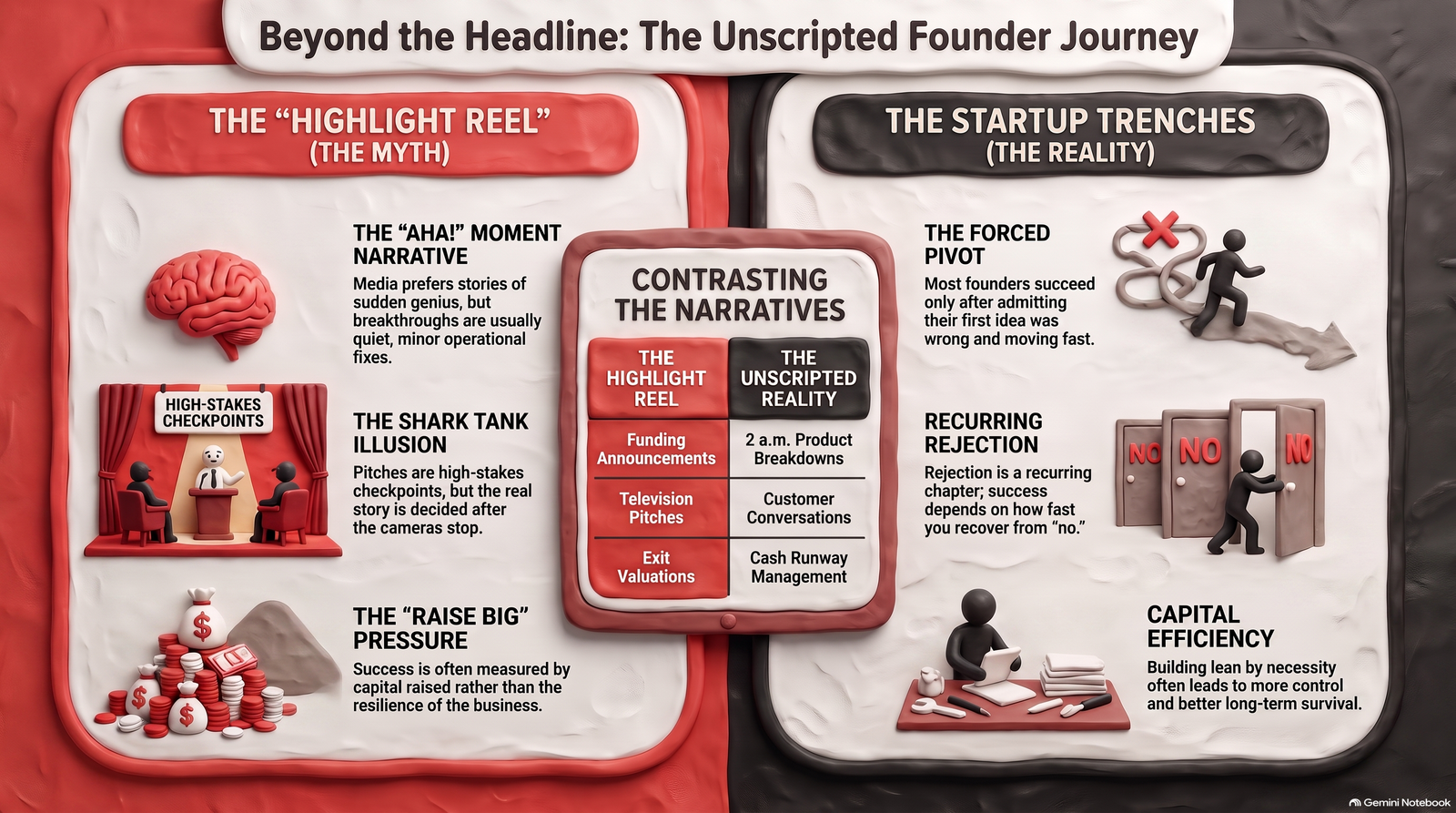
Across dozens of founder interviews, a few honest patterns show up again and again — far more often than the “aha moment” narrative most media coverage prefers.
1. The First Idea Is Rarely the Idea That Works
Almost every founder we’ve spoken with pivoted at least once, and often the pivot wasn’t strategic — it was forced. A product failed to find users, a market turned out to be smaller than expected, or a customer conversation revealed a completely different problem worth solving. The founders who made it through didn’t have better first ideas. They were just faster at admitting the first idea was wrong. Not every pivot works out, either — our feature on Elcare India’s rise and fall is an honest look at what happens when the market doesn’t cooperate, even with a genuinely good idea.
2. Rejection Is a Recurring Chapter, Not a One-Time Event
Whether it’s investor rejection, a Shark Tank India pass, or a product launch nobody notices, rejection shows up repeatedly in every founder journey we’ve documented. What separates founders who continue from founders who quit isn’t immunity to rejection — it’s a shorter recovery time between hearing “no” and making the next move.
3. The Team Story Is Usually Messier Than the Founder Story
Co-founder exits, early employee churn, hiring mistakes made under pressure — these rarely make it into polished founder profiles, but they come up in almost every unscripted interview. A founder journey is never really a solo journey, and the people who left are often as instructive as the people who stayed.
4. Capital Efficiency Beats Capital Raised
Some of the most resilient founders we’ve interviewed raised the least money, not the most. They built lean by necessity, made peace with slower growth, and ended up with more control over their own company when the funding climate turned cautious. This runs counter to the “raise big, scale fast” narrative that dominates startup media — but it’s a theme that shows up constantly in real founder conversations, including in Jain Shikanji’s journey from a family legacy to a national brand and Cocofit’s coconut-powered wellness build-out.
5. The Turning Point Is Almost Never Dramatic
Founders describe their breakthrough moments in surprisingly quiet terms: a repeat customer, a small feature that unexpectedly reduced churn, a single cold email that turned into a distribution partnership. The dramatic pitch moments make good television. The quiet operational fixes are what actually built the company.
Lessons From Shark Tank India Founder Journeys
Shark Tank India has become one of the biggest entry points into entrepreneurship stories for a mainstream Indian audience, and it’s created a specific sub-genre of founder journey — the pitch as a single, high-stakes checkpoint in a much longer story.
What’s worth noting for anyone following these journeys: the pitch itself is rarely the turning point founders describe when asked later. Many say the real inflection came from the visibility and customer trust the show generated afterward, not the deal terms discussed on stage. Some walked away without a deal and still saw their business change permanently because of audience reach. Others took a deal that never fully closed, and had to rebuild their growth plan around bootstrapped capital anyway.
The pattern holds: even in India’s most televised founder journeys, the unscripted follow-through after the cameras stop is where the story actually gets decided. Our conversation on Pharmallama’s regulatory challenges and lessons from Shark Tank India is a good example — the pitch was just the opening chapter, not the resolution. For more founder-side accounts like this, browse our Startup category and Entrepreneur interviews.
What Aspiring Founders Can Take From These Stories
If you’re building something right now, here’s what consistently shows up across the founder interviews we’ve published:
- Talk to users before you build for them. Nearly every founder who avoided a painful pivot did so because they validated the problem early, not the solution.
- Expect the team to change. Plan for it emotionally and operationally rather than treating it as a personal failure when it happens.
- Track cash before you track growth. Founders who survived downturns were the ones who understood their runway down to the week, not the quarter.
- Rejection is data, not a verdict. The founders who kept going treated a “no” as one data point among many, not a final judgment on the idea.
- The story you’ll tell later is being written now, in the boring parts. The unremarkable Tuesday spent fixing a support ticket is usually more decisive than the headline moment.
Why We Document These Stories at OnlyInterviews

We built OnlyInterviews around a simple belief: the startup ecosystem in India has plenty of coverage of outcomes, and very little honest documentation of process. Every founder we feature is asked the same underlying question in different ways — not “how did you succeed,” but “what actually happened.” That same principle shapes our broader My Story series, where founders, athletes, and creators talk through the messier middle chapters of their journeys, not just the milestones — like Kavitark Ram Shriram’s journey from Chennai to Silicon Valley.
That distinction matters for anyone using these stories to make real decisions about their own venture. Inspiration is easy to find. Specific, honest detail about how a founder navigated a cash crunch, a co-founder split, or a failed launch is harder to find — and far more useful.
If you’re a founder with a story worth documenting, get featured on OnlyInterviews and share your journey with our readers. If you’re a reader trying to learn from people who’ve been through the early, uncertain stages of building something, our Candid Interviews section is built for exactly that.
Frequently Asked Questions
What makes a founder journey story genuinely inspiring, rather than just promotional?
Specificity. Stories that name the actual numbers, the actual mistakes, and the actual timeline tend to resonate far more than stories that only describe the outcome.
Are Shark Tank India founder journeys representative of most Indian startups?
Not entirely. They’re a useful and visible sample, but most Indian founder journeys happen without a television audience, over a much longer and quieter timeline.
Where can I read real, unfiltered founder interviews from Indian entrepreneurs?
OnlyInterviews publishes founder interviews focused on the operational and emotional reality of building a startup in India, beyond the funding headlines. Explore our Entrepreneur category for more.
This article is part of OnlyInterviews’ ongoing founder interview series, where we document the real, unscripted journeys behind India’s startup ecosystem. Read more on our About Us page, or get in touch if you have a story to share.