
 By onlyinterviews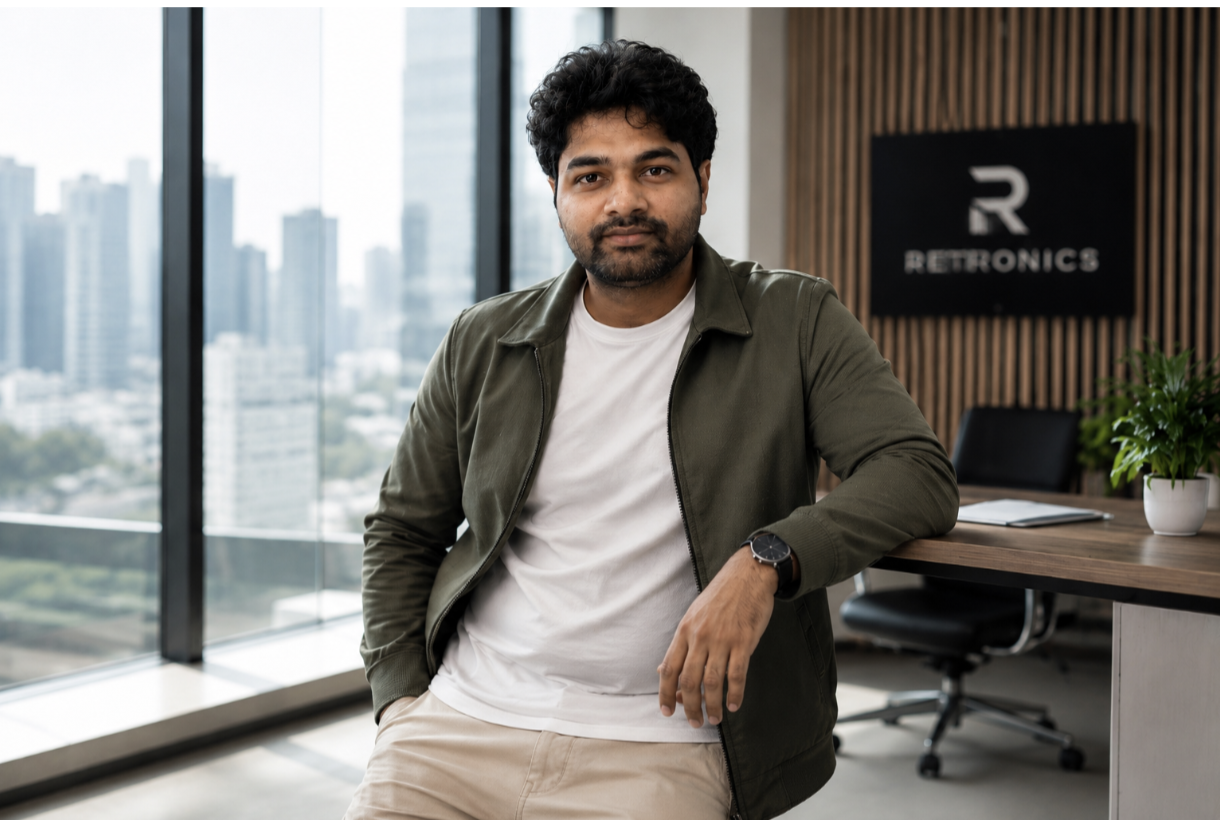
From Telangana classrooms to Britain’s circular technology market, Arun Teja is working on a problem most people in the refurbished electronics industry have learned to live with.
The Question Nobody Was Asking
There are founders who chase trends, and there are founders who spend years staring at a problem until the rest of the world finally sees it. Arun Teja belongs to the second kind.
Soft-spoken and methodical, Arun does not carry the loud personality often associated with technology entrepreneurs. He is not a founder who fills a room with slogans. He tends to listen carefully, think for a moment, and then ask the question that reframes the conversation.
In the refurbished electronics market, that question was simple: why do people still feel afraid of used phones?
Not because the devices lack value. Not because the demand is absent. Not because sustainability has failed to capture public attention. The deeper issue, Arun believed, was trust. Buyers were afraid of hidden defects. Sellers were afraid their personal data might survive after resale. Families kept old phones in drawers, not because those phones were useless, but because they did not feel safe letting them go.
“The issue is not that people do not want to buy refurbished. The issue is that they cannot tell whether what they are buying is actually in the condition it is described as. Those are solvable problems. We just have not treated them as engineering problems before.”
Where many saw a resale problem, Arun saw a human problem. And where many companies tried to solve it with better listings, cleaner photos, or cheaper prices, Arun approached it as an engineer.
From Telangana to the UK: An Engineer’s Mindset
That instinct was shaped long before Retronics Marketplace UK Limited existed. Arun grew up in Telangana, completed his engineering degree at the National Institute of Technology Kurukshetra, and eventually made his way to the United Kingdom — carrying with him, by his own account, a fairly straightforward belief: that if you are going to put your name on something, it should actually work.
“Engineering, for me, was never just about building things. It was about being accountable for what you build. If someone depends on it and it fails, that is on you.”
That framing followed him to the United Kingdom, where he began building Retronics around a fairly pointed observation: the refurbished electronics market was asking buyers to trust sellers, when what buyers actually wanted was evidence.
Like many founders who have built businesses in the UK after moving from elsewhere, Arun is aware that the work itself has to do the talking. He is not operating from an established network or a well-known institutional background in Britain. The company has to earn its credibility from scratch.
“You cannot shortcut your way to being trusted. You can spend money on it, but you cannot fake it. At some point the product either delivers or it does not.”

What Retronics Is Building
A Verification Layer for Used Devices
Retronics is currently developing what the company describes as a verification layer for used devices. The work includes AI-driven diagnostics, a Digital Device Certificate, secure data-erasure tools, and predictive condition insights — all aimed at making the state of a second-hand phone more transparent to both buyers and sellers.
The problem he is addressing is real enough. Across Britain, a significant volume of used smartphones sit unused — not because they have no value, but because their owners are uncertain whether to sell them or trust what they might buy in return.
The Digital Device Certificate
The used phone market has long relied on surface-level checks. A device is photographed, graded, run through basic tests, and relisted. The screen looks clean. The camera opens. The battery shows a percentage. But Arun argues these checks leave the most important questions unanswered: What is the actual health of the battery under load? How has the device been used? Has personal data been properly removed?
The Retronics Digital Device Certificate is the company’s attempt to answer those questions systematically. Rather than treating a phone as an object to be visually inspected, the system analyses it as a machine generating data: battery behaviour under different conditions, thermal patterns, touchscreen response, wireless performance, camera function, and sensor readings. The output is a condition profile intended to give buyers and sellers a shared factual basis for the transaction.
“A grade label like ‘Grade A’ or ‘Like New’ is just an opinion. We want to give people something measurable. Not a claim — a record.”
The contrast he is drawing is straightforward: the existing market asks buyers to trust a description; Retronics wants to give them a verifiable record instead.
In Arun’s framing, a phone is not simply “working” or “not working.” It carries a usage history, accumulated stress, and ageing patterns that surface-level grading does not capture.
“Anyone can take a photo of a clean screen and write ‘excellent condition’. That tells you almost nothing about the battery, the internals, the data state. We are trying to build something that goes much deeper than that.”
Forensic Wipe-Out: Solving the Data Fear
The data concern is something Arun takes seriously. Most people, he notes, do not sell old phones primarily because of inconvenience — they hold onto them because they are not confident their personal files, photos, and financial information will actually be gone.
The company’s Forensic Wipe-Out framework is aimed at the seller side of that problem — providing a verified data-erasure process so that people can hand over a device knowing their personal information has been properly cleared, and buyers can see evidence of that clearance.
It is a practical gap. The refurbished market has grown considerably over the past decade, but the infrastructure for verifying what is being sold has not kept pace. Arun’s argument is that closing that gap is not a marketing problem — it is an engineering one.
“We are not trying to persuade people to trust us. We are trying to give them something they can actually verify. There is a big difference.”
Who He Is Building This For
Arun is careful to keep the end user in the frame when discussing the technology. He talks about the student buying an affordable phone on a tight budget, the parent who wants to sell an old device but worries about their photos, the small business owner who needs reliable hardware without paying new-device prices.
“If someone is spending their savings on a second-hand phone, they deserve to know exactly what they are getting. That is not a luxury feature. That is just basic respect for the buyer.”
Those who have worked with Arun describe him as methodical. He does not appear particularly interested in building a brand that generates attention before it has something to show. His focus, from conversations with him, seems to be on making the underlying technology defensible first.
The Bigger Picture: Sustainability and Market Trends
The broader context matters here. UK consumers returned or scrapped an estimated 40 million unused electronic devices in recent years, according to industry research. The environmental case for extending device lifespans is well established. But Arun’s argument is that sustainability in this market will not be driven by awareness campaigns alone — it depends on whether buyers and sellers actually feel secure enough to participate.
“People are not going to reuse things just because they are told it is good for the planet. They will do it when they feel like they are making a sensible decision. That is what we are trying to make possible.”
Retronics sits at the intersection of several trends that have gathered momentum independently: the growth of recommerce platforms, increasing interest in digital product passports, rising consumer concern about e-waste, and growing demand for affordable technology from cost-conscious buyers. For Arun, these trends point toward a clear opportunity: the refurbished electronics market needs stronger systems of trust if it is to become a truly mainstream global category.
Building for the Long Term
Arun is not building Retronics for a short-term exit, a temporary experiment, or a moment of attention. His ambition is to build a long-term, sustainable technology company — one that can scale responsibly, generate significant commercial value, and grow into a trusted verification standard for second-life electronics across international markets. He describes Retronics’ focus as systems, verification, repeatability, and scale: the foundations of a company built not only to survive, but to expand.
What is clear from talking to Arun is that he is thinking far beyond a single product or a single country. He is building toward a future where Retronics can serve millions of users, support businesses across the refurbished electronics ecosystem, and bring verified second-life technology to markets around the world. The goal is not simply to participate in the circular economy, but to help define the trust infrastructure that allows it to grow globally.
“A certificate is only worth something if the process behind it is real. Anyone can print a claim. We are trying to build the thing underneath the claim.”
This is not a small product idea. Retronics is being built with a long-running company vision: to become a scalable technology business that makes refurbished electronics safer, more transparent, and more trusted for buyers, sellers, and businesses. The work begins with diagnostic infrastructure, but the ambition is much larger — to build the verification layer that allows second-life electronics to become a mainstream global market.
From Telangana to NIT Kurukshetra, from India to Britain, Arun’s journey has not followed a straight line. But the direction of his work has remained consistent: find the problem others have accepted as normal, treat it as an engineering challenge, and build a company strong enough to solve it at scale. Retronics is being built to last, to expand, and to reach customers wherever affordable, verified, and trusted technology is needed.

Where Things Stand
Retronics’ success will not be defined by short-term market attention alone. Arun is building the company with a long-term vision: to create a sustainable, scalable business that can generate meaningful revenue while changing how refurbished electronics are trusted across the world. Market timing, reseller adoption, regulation, and consumer behaviour will all play a role, but the direction is clear. The need for verified, affordable, and secure second-life technology is growing — and Retronics is positioning itself to meet that need at scale.
He does not describe Retronics as a temporary experiment or a narrow marketplace play. When asked how he sees the company’s future, he frames it as infrastructure for a global circular technology economy.
“We are trying to make it so that buying or selling a used phone does not require a leap of faith. It should be based on evidence, verification, and trust. Our goal is to build that standard not just for one market, but for every market where people need safe, affordable, and reliable technology”
Retronics is still building, but it is building with serious long-term ambition: to become a company that lasts, scales, creates commercial value, and reaches customers across international markets. The challenge of changing how an entire industry approaches verification is not small, but Arun’s view is that this is exactly why the work matters. The question he started with why do people still feel afraid of used phones is not going away. And neither is his commitment to building a company strong enough to answer it properly.
Retronics Marketplace UK Limited is based in the United Kingdom and is developing verification tools for the refurbished electronics market.